

"WE ARE BORN NAKED..."
1 CIRCLING AND CLARIFYING. Not long ago, I wrote that Hannah Villiger's work can be divided into stages. Looking back over her fifteen years of work, this is true in a certain sense. First there were the objects, such as spears, which were made from found, collected and then processed materials and were virtually designed for rituals and ceremonies. This was followed shortly afterwards by her first black-and-white photographic works, mostly small series and sequences of observed or staged events that depicted various movements or states of energy in space – floating, shooting up, foaming and falling – and, at least in the example of the falling and burning palm frond, referred to the archaic and mythical. At the beginning of the 1980s, there was a shift to colour, to colour SX-70 Polaroid material and to images that, arranged in rows and blocks, were highly metaphorical, suggesting a first reading – two hands touching; legs stretched like a spring; a backside covered in bright red leather and held in the grip of a hand; a thread that "eats" into the corners of a made-up mouth – suggesting a second or further readings. In doing so, they told, as in the work mentioned here, the story of a relationship between two women characterised by closeness and distance, warmth and coldness, possibilities and obstacles.
The narrative soon faded, and the central feature of Pola's films, instant development, came to the fore when Hannah Villiger began to change the "material", the motif, and from then on made almost exclusively herself, that is, her body, the object of observation: her own body as the reliable and verifiable, the free and binding in one; the Performance is inherent in all three disciplines, and Hannah Villiger's photographic work is characterised by this. In a further stage, as Jean-Christophe Ammann put it, she lost sight of the object of her perception: "Perception that becomes the object of perception itself, dissolving the object into sheer insignificance because the emptying of the gaze becomes identical with its consistency." The motifs, the body parts, became increasingly thin-skinned, paler, more abstract, very much "painful," "unbearable" in the imagination, because the object "has detached itself from itself,"* but perhaps also, to some extent, less binding in its visual appearance and attitude, because the works quickly approached the zero point of white image surfaces.
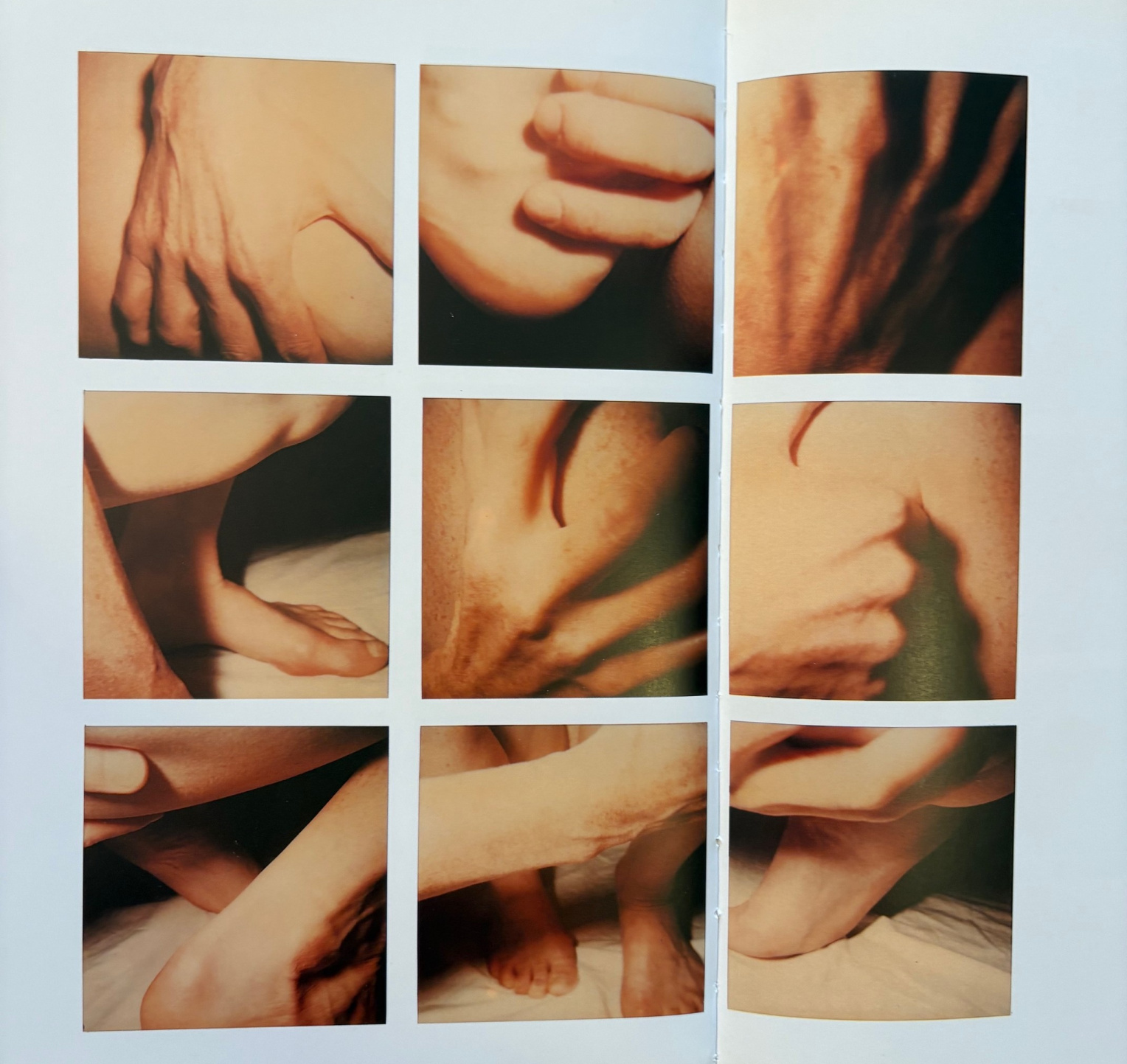
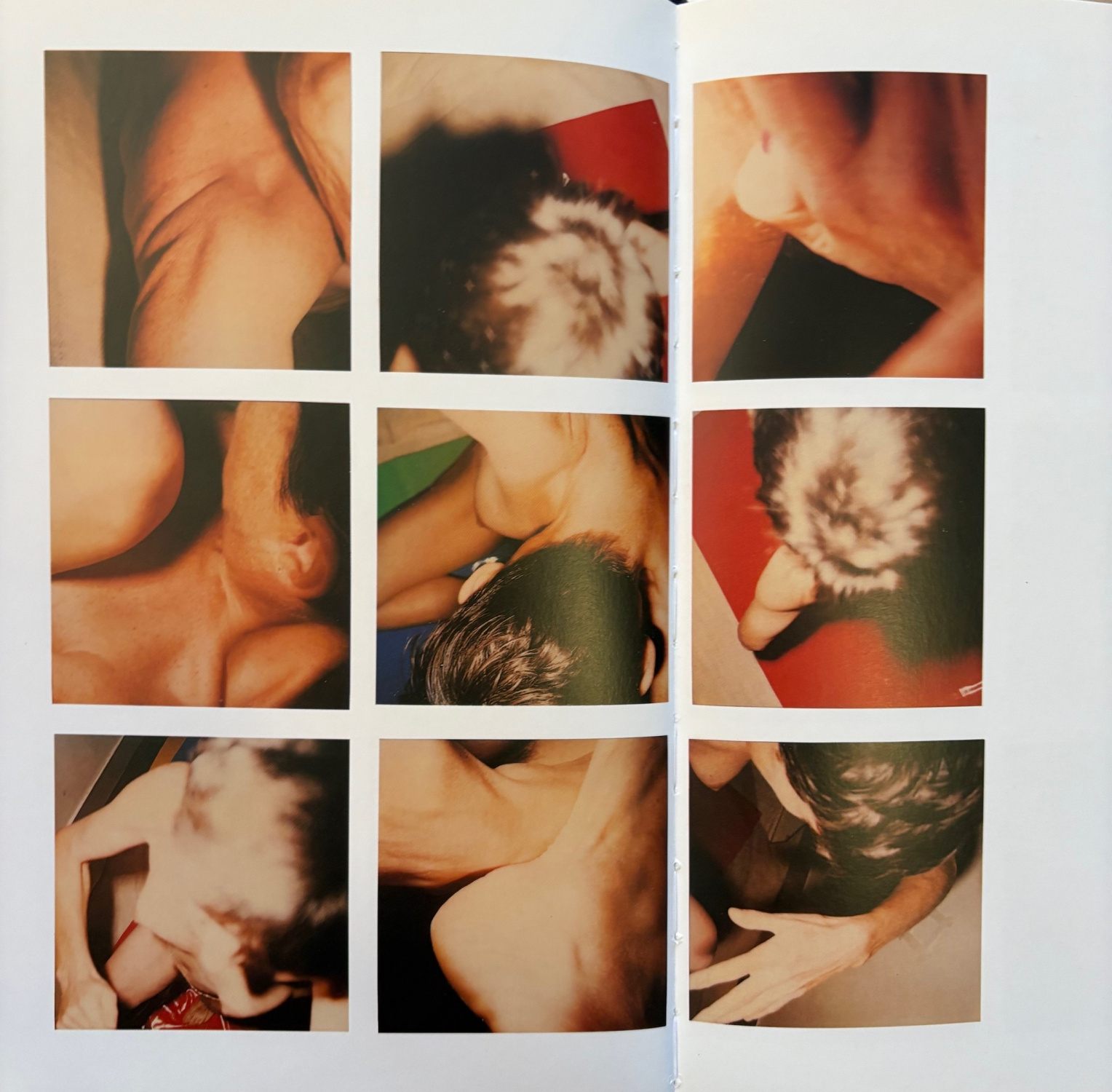
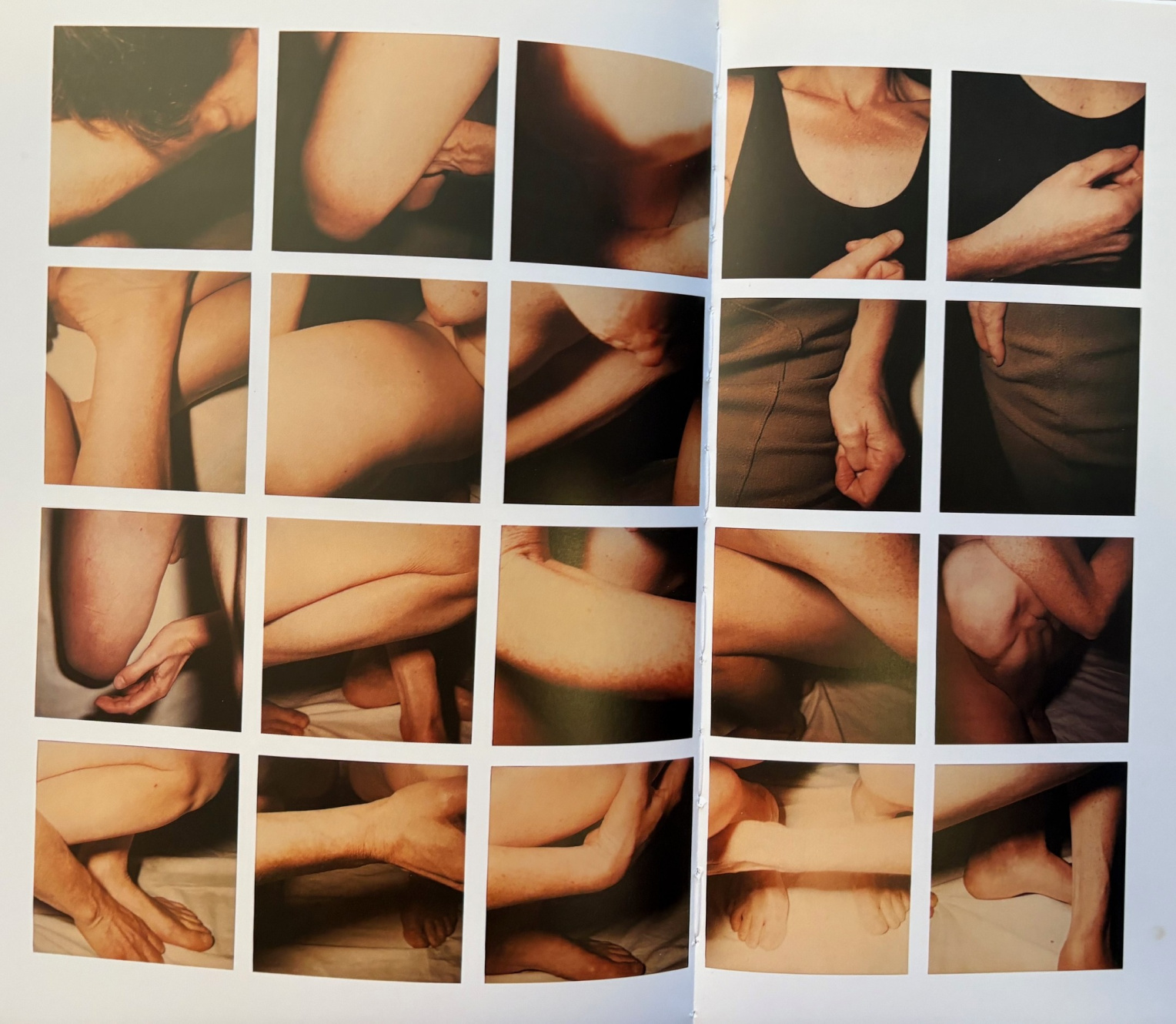
The view outside, onto a snow-covered square frozen in the cold or onto a densely leafed, lush green tree, and the shifting of the framing into the picture – using white sheets of paper to crop and cover parts of the body while revealing others – freed the works from this zero point and expanded their visual vocabulary. The image blocks that Hannah Villiger began to assemble in 1988 also represent an expansion. Six, nine, twelve greatly enlarged Polaroids, arranged in groups of two by three, three by four, three by three and four by five, break up the small-scale image and also the series, because a field of signs opens up that either harmonise or contrast, but are in any case richly interconnected. And finally, some of the latest works, which show the body from a greater distance and are therefore less fragmented. Here, the artistic body of H. V. once again becomes more strongly the body of Hannah Villiger.
These are all stages on a certain path, but until now I associated them with the idea of a more or less linear development, a progression from one to the next. I can no longer recognise this progression; rather, it seems to be a circle, a circular movement that swings out, narrows and intensifies from time to time, only to eventually run out again. A circling in which similar images recur in a different context, with a related or decidedly different meaning. A circling in which Hannah Villiger repeatedly comes back to herself, gets closer to herself, expresses herself more strongly and directly in her work, and then distances herself again, using her body like a building block, like an artist uses his pencil. Overall, the loneliness that Jean-Christophe Ammann speaks of, and the despair that was palpable, have given way to a greater closeness to herself, a greater warmth in the images. Overall, it is obvious that Hannah Villiger emphasises the processual, the "defence against a definitive, result-oriented solidification": "Fixed points of view, gravity, are suspended rather than sought after."
2 NAKED AND NAKED. We must talk about two types of exposure, even if they can become indistinguishable in the pictorial result. Hannah Villiger shows parts of her body naked, and she also exposes herself through the camera, through the way she uses it. However, it is not easy to speak of a double nudity, because the two exposures can also cancel each other out, but rather of a doubly monstrous risk: a woman who shows herself naked in photography, the medium that has most conveniently and most enduringly absolutised the male projection of the image of women per se. And she does so with a camera gaze that shows the body as directly and closely as we usually only know from the medical or pornographic gaze.
"We are born naked, we only have ourselves, and it is ourselves that give us everything." This quote from Hannah Villiger suggests what she is venturing to do. As a visual artist, she wants to work not with just any material, but with the closest, most obvious material: her own body as the primary "material" and the primary, binding standard. In both physical and visual reality, this initially meant carefully exploring the body and the images that are possible from and with it, gradually reclaiming everything that is externally determined on various levels of reality and can only be perceived through a very specific grid. Only through this experimentation and reclaiming can the body become the measure of all things, the beginning and end of artistic work. In this sense, Hannah Villiger's work can be understood as feminist, as real women's work, even if she herself has hardly ever explicitly proclaimed this.
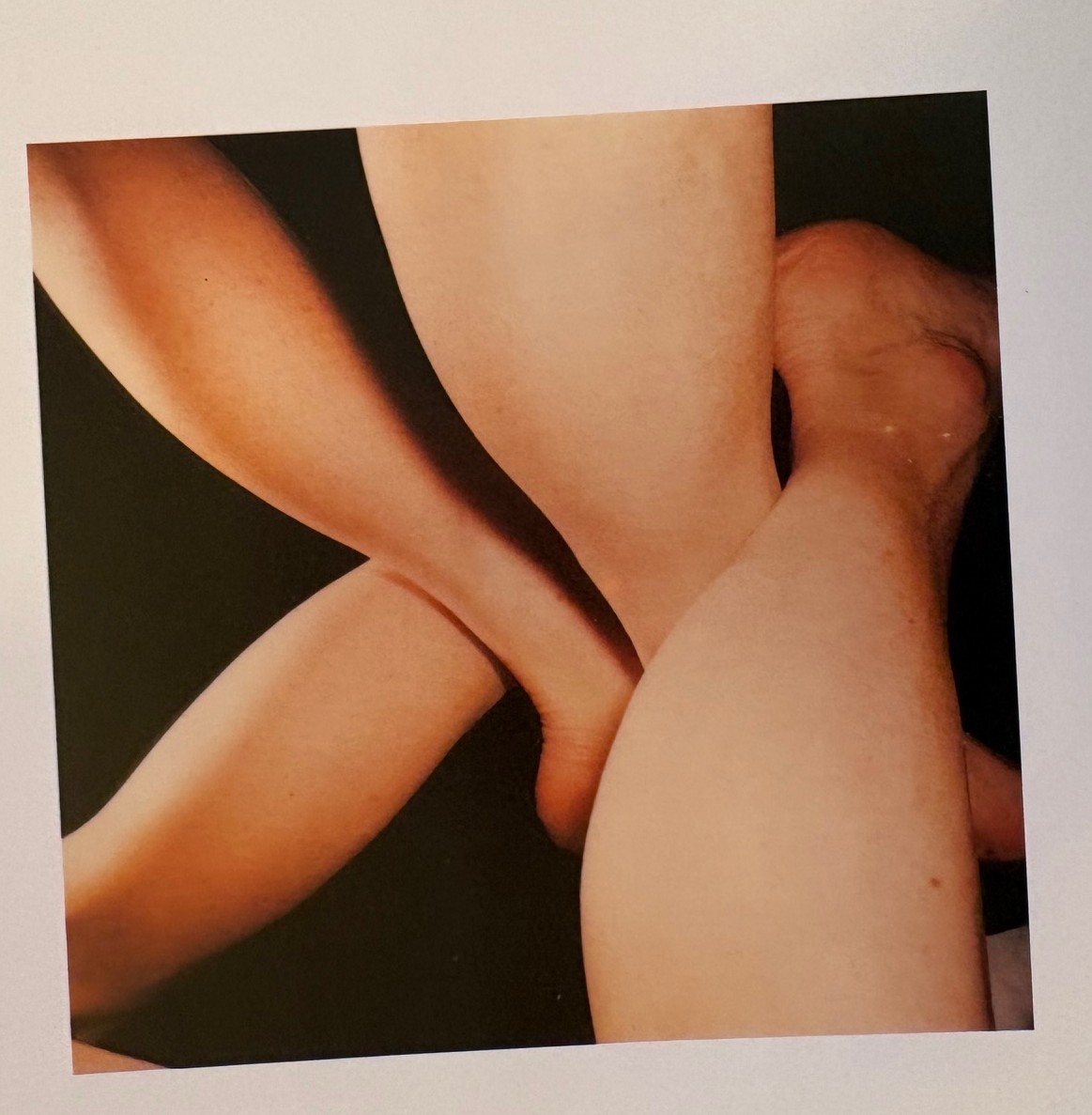
Through her direct, naked exposure and self-exposure, Hannah Villiger shifts the common opposition between being dressed and naked, indeed, she radically breaks down the omnipotence of this opposition and the tensions that accompany it, opening up in return a rich field of diverse "nudities" that are not so clearly definable and not so easily meaningful. "Hannah Villiger works with and against the romanticism of her own body ..." Christiane Meyer-Thoss noted, initially it was almost exclusively the latter and more than that: with a striking focus on arms, legs, hands and feet, i.e. on rather neutral limbs, avoiding gender-specific characteristics and strongly cropping the body, she attempted to escape the common metaphorical connotations of the body. Sometimes so strongly that the very tight and harsh cropping and the bright, sometimes glaring and burning light, in almost every case without shadows, shifted the meaning of the characteristic "naked" from the realm of emotions to the field of circumstantial evidence, and it was less the body fragments than the washed-out Pola colours that functioned as carriers of emotion.
It was always visibly a woman, a woman's body, a part of a woman's body that was depicted, but since the photographic works were initially characterised by defensiveness, they were of a brittle sensuality, tending towards the neutral, as far as possible without any reference to the sexual. Occasionally, something tender was allowed, but otherwise the works were characterised by a relentless, direct, almost torturous exploration of the body. As a whole, they conveyed an image of existential sharpness. Hannah Villiger gained her first taste of freedom when her photos lost their perspective depth and the body parts lost their plasticity, while at the same time the colours, which had always been reddish, bluish and yellowish, became even paler. In doing so, she detached the skin from the body, as it were, and used it as a pictorial means for increasingly abstract images.
The idea of nakedness only comes full circle when nakedness is not only unprotected and vulnerable, but can also mean open and sensual. This seems to be fulfilled in the works of the last three years: a neck that presents itself proves to be not only weak and vulnerable, but also a very sensual part of the body; her own hand forms a kind of rouleau, which, in the interplay of openness and concealment, entices the viewer to look at the body behind it; the skin may now appear velvety and sensual, not only in bright tones, but also in darkened, warm tones; the background colours become richer and more radiant; and certain signs can certainly have an erotic signal character. Above all, however, the face, breasts, vagina, pubic hair and hips now belong quite naturally to the pictorial vocabulary, even if they sometimes appear as something else or are broken in their uniqueness by the serial nature of the work. The path of defence, exploration and conquest seems to lead to a sense of ease, thanks to which nudity regains its erotic seductiveness and shadows are once again allowed to harbour secrets. Even the use of stockings, bottles and bright colours, i.e. strong symbols and unambiguous signs, has become possible – under completely new circumstances.
3 INSIDE AND OUTSIDE. Hardly any of Hannah Villiger's images are symmetrical or even concentric in structure, even though she works with the almost square format of Polaroid SX-70. And when it does happen, it is most likely a blurred spot floating in the centre of the square, a rotating body, for example, photographed from above, a dizzying Hannah Villiger. The goal of her work is not to create something fixed, clear, and calm, nor is it to combine unambiguous colours with unambiguous symbolism and meaning. The images tell a different story: neither the space nor the figure is predetermined. The image background, image space and figure are variable; they are constituted for just a moment, only to shift against each other again immediately. This constellation alone conveys an image of fragile balances, of dissolution, of intense fragmentation at times.
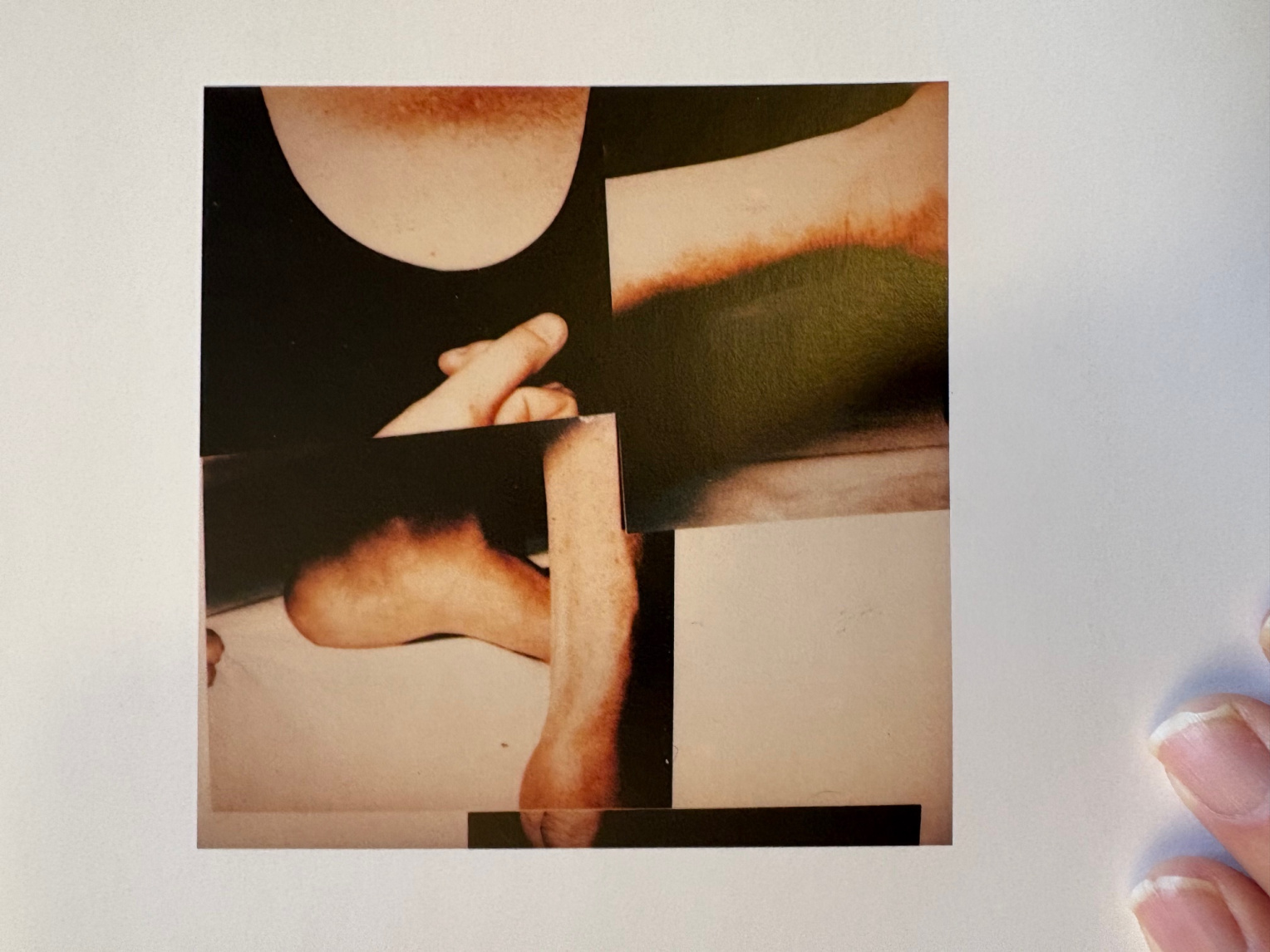
Hannah Villiger has also scanned her body with the camera in such a rebellious manner at close range, unwrapping and unwinding it, dismantling and dividing it, that any unity, the person, the body as a whole, is dissolved and presented individually side by side in extreme cropping. This reinforces the intention and multiplies the fragmentation. Extreme cuts, as known from surrealist photography, extreme angles – steep overhead views, as in the photography of the 1920s – and quite often a rotation of the finished photograph by 90° or 180°: All of this alters body parts and spatial structures to such an extent that they are torn from the foundations of familiar perception, causing the viewer's gaze to float because they cannot focus properly, because they can no longer reliably distinguish between top and bottom, inside and outside.
All limbs, all pictorial elements extend beyond the edges of the image, striving outward. When hands and feet enclose each other, creating the impression of a closed energy cycle, only the hands and feet are visible. The real body, the wholeness of the basket in both the literal and metaphorical sense, is presented to the viewer outside the image, if at all. Hannah Villiger leads our gaze to a point, the point of a connection, a tension, a latency, and from there our gaze explodes, wanders, crests, leaves the image and returns again. The use of visible or invisible mirrors, sometimes also of aggressively appearing mirror shards, potentiates this explosive moment. Everything doubles, multiplies. The body parts unfold like paper cut-outs and, in a reversal of the original design, reach out towards the image. No longer just a dialogue between limbs, but rather a trialogue, a murmuring of limbs takes place. The images become poly-perspective.
The dismemberment and fragmentation of the body and the breaking down of the image's boundaries find their logical continuation in the sequencing and block-like organisation of images. The sequential arrangement of the photos further fans out the visual world, accelerates it and builds in a moment of tension. Serial sequences allow for a narrative that goes far beyond the images. The joining of disparate forms leads to tension-filled structures. And here, too, caution against a strict and harmonising order leads Hannah Villiger to repeatedly incorporate a kind of disruptive element into the blocks, as if she wanted to make it clear that it is never about lifelike ideals, but rather about a shattered form of life that needs to be rearranged. Finally, when we enter an exhibition room in which individual images, series and blocks face each other, our perception is once again thrown off course, because we are standing in the middle, surrounded by outer skins. Outside and inside have been reversed. Nevertheless, an unexpected calm descends on the exhibitions: despite all the heterogeneity, the similar colours merge into a colour landscape and the many links come together to form an organic-looking network. At the latest in the exhibition staging, it becomes apparent how strongly Hannah Villiger combines painterly and sculptural elements in her photo performance. For some of her latest works, the camera took a nice step back. It is now more difficult to identify the performer as Hannah Villiger from the clues provided; the distance is too great. But it is precisely this distance that allows for a new closeness to humanity, to womanhood, which is radiated by a closed, holistic, pregnant body.
4 DEFINITELY UNDEFINITE, Right at the beginning, Hannah Villiger worked with analogies. Something, a sign, was chosen and set so that it refers to itself, but always also to something else. A mouth painted red, pierced by a thread, speaks of violence and suffering. However, as soon as she began to use only her own body, the metaphorical transition disappeared, and it became almost exclusively about the literal, the skin, the scene itself. I can say that this reflection of legs looks like a flower, these limbs have the colour of marble, of washed-out bones or frozen flesh, this scene seems amphibious, this skin stony or papery. These body parts are intertwined like lianas, these nipples and areolas look like planets – but these comparisons mostly remain without any overarching meaning. They only help to overcome the speechlessness in front of the images. The works are enigmatic, they avoid any ambiguity so strongly that the constellation of signs in the images remains one step away from a fixed, definable meaning. It is up to the viewer to endure this latency or to connect the set signs to a meaning. This determined indeterminacy, combined with the detachment from the object, emphasises the fluid, processual nature and offers Hannah Villiger the opportunity to use her own body as an image alphabet, as image building blocks for a wide variety of images. After the rigorous, restrictive decision to choose exclusively her own body as a "motif", the range of possibilities for creating calm or expressive, abstract, flowery or sensually seductive images suddenly becomes very wide, very open and very rich in nuances.
And yet, despite all the detachment from the subject, it is still her skin that she carries to market and puts on display. It is astonishing that, unlike other current examples, this does not seem embarrassing for a moment. Shivering, sickly, even caustic at times, and on the other hand poetic, romantic, sensual, but never embarrassing. This can be attributed to the skin itself, which, although it has distinctive features with its many freckles, otherwise appears to be "just" skin, neither elegant nor vulgar, neither young nor old. It can also be attributed to the special gaze, which so clearly avoids clichés that we hardly ever feel like voyeurs or onlookers. I think it is due to everything, but primarily to the absolutely serious, long-standing, almost ascetic and only later recognisably sensual examination of herself, her own body and the possible images. A kind of engagement that was so out of step with the zeitgeist and contrasted so strikingly with the colourful, cheerful, cynical imagery and with the notions of art as (critical) entertainment. Hannah hairy bodies, the motifs – torso, feet, legs, hands, penis – appear more as objects in the pictorial space, as curious, alienating objects in the course of their time. In contrast, Hannah Villiger's images are less a record of an event, less a search for clues or a chronicle of life. She is not primarily interested in the specific moment in time, but rather in developing and fighting for something of her own, something personally essential or universal, based on the concrete reality of her own body, which she cannot abandon.
Comments
1 Urs Stahel/Martin Heller: Important Images – Photography in Switzerland, Zurich 1990, p. 34. 2 Hannah Villiger: Work, 1980/81, photograph based on a Polaroid, mounted on aluminium, 355×475 cm. 3 Jean-Christophe Ammann: Geduld und Einsamkeit (Patience and Solitude), in: Stiller Nachmittag – Aspekte Junger Schweizer Kunst (Quiet Afternoon – Aspects of Young Swiss Art), catalogue of the exhibition at the Kunsthaus Zurich, 1987, p. 183. 4 Jean-Christophe Ammann, as in note 3, p. 183. 5 Christiane Meyer-Thoss: Die Bildhauerin Hannah Villiger, in: Hannah Villiger: Skulptural, catalogue of the exhibition at the Museum für Gegenwartskunst Basel, 1988/89, p. 62. 6 Christiane Meyer-Thoss, as in note 5, p. 61. 7 Leo Delfgaauw: John Coplans. Archaeologist of the own body, in: Perspektief, quarterly magazine for photography, no. 34, Rotterdam 1988, p. 42.